On June 11, 2023, Ubisoft released the first trailer for Star Wars Outlaws. Outlaws follows smuggler Kay Vess as she navigates the perilous galactic underworld in the year between The Empire Strikes Back and Return of the Jedi. At the 1:38 mark of the trailer, Kay confronts a man named Jaylen in the cockpit of her ship, and seated next to Jaylen is…a BX commando droid in a trench coat?? I no longer have my past tweets to prove it, but rest assured that, as someone obsessed with both droids and the Confederacy of Independent Systems, I was freaking out.
I wasn’t alone. The reveal of ND-5 in the first Outlaws trailer was followed by a kind of public thirsting heretofore unseen in the online Star Wars community, with person after person expressing their desire to do unspeakable things to a Separatist battle droid. “Oh No, The Star Wars: Outlaws Robot Is Hot,” proclaimed a headline in The Gamer. An article in Gizmodo asked “How Did Star Wars Outlaws Make a Droid So Hot?” and identified a number of elements contributing to ND-5’s sex appeal, including his height, his slender form, his coat, and the scar across his chest. The game’s developers, who insist that they didn’t set out to make ND-5 hot, were taken off guard by the reaction.
ND-5 is a supporting character in Star Wars Outlaws and a co-protagonist, with Jaylen Vrax, in Low Red Moon, an Outlaws prequel novel written by Mike Chen. Low Red Moon is arguably the first Star Wars book to feature a droid in such a prominent role. The book alternates between Jaylen- and ND-5-centric chapters, and while Jaylen’s chapters are written in third-person past tense, ND-5’s chapters are in first-person present tense.
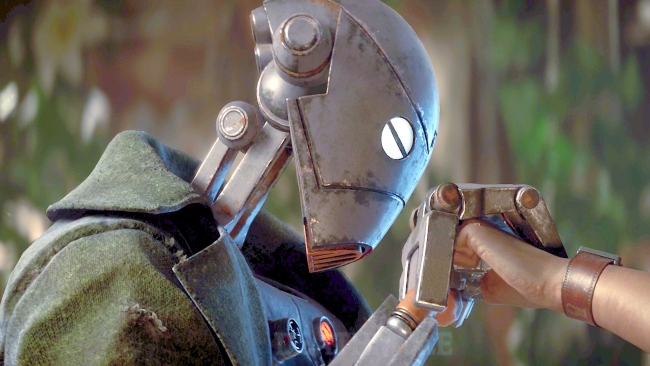
The Disney era has introduced a lot of great droids. ND-5, however, may be one of the most important, and not just because he’s good-looking. Low Red Moon comes closer than any other piece of Star Wars media to putting a droid character on a level playing field with their organic counterparts. By bringing us into the mind of ND-5 and letting us see the galaxy through his eyes, Low Red Moon offers compelling insight into how droids are treated and perceived, and it invites us to consider how droids are portrayed in Star Wars and science-fiction media more broadly.
As I discussed in my article on droid rights, the status of droids in Star Wars is messy. Depending on the story and the droid in question, droids are sometimes pets, sometimes children, sometimes tools, and sometimes friends. That’s one of the reasons why Star Wars droids fascinate me so much. Droids are a kind of Rorschach test: what a character sees in a droid — and what we as viewers and readers see — says as much, if not more, about them — and us — as it does about the droid. This is especially true in Low Red Moon, which offers an extended look at a relationship between an organic and a droid.
Arguably the central tragedy of Low Red Moon is that Jaylen is ND-5’s friend, but Jaylen is not ND-5’s friend. On the day that Jaylen is set to become CEO of his family’s shipbuilding company, he and the rest of the Barsha family are arrested by the Empire on charges of treason and placed on house arrest at a resort on the moon of Gus Treta. ND is sent to Gus Treta by Jaylen’s half-brother Sliro, who works for the Imperial Security Bureau and resents the lifelong neglect he’s endured from his father and stepmother because he wasn’t a “full Barsha.” Sliro inserts an override chip into ND that orders him to kill the entire Barsha family. ND eliminates all the Barshas except Jaylen, who manages to install a restraining bolt on ND as well as a program that forces ND to serve him. From then on, ND-5 is a means to an end, a “tool” and an “asset” that Jaylen uses to rebuild his life in the underworld. Even after a droidsmith confirms that the override chip was damaged during ND’s mission, thus making the restraining bolt unnecessary, Jaylen insists that ND wear one. Jaylen then constructs an elaborate web of lies to “corner ND-5 into subservience.” He presents the override chip as an ongoing threat, telling ND that if he were to remove the restraining bolt or “tap into any Separatist-specific skills,” ND might become a killer again or even turn back into a regular commando droid. As Jaylen saw it, he “had to seal off any notion the droid had of freedom,” believing that “any permission to think invited an inherent risk.”1
ND bristles at the constraints placed on his autonomy — on several occasions, he presses Jaylen to let him download skills that would be valuable to a job, or to go to a droidsmith who could fix the override chip once and for all. Each time, Jaylen either repeats the lies or insists that they’ll get around to it later. All the while, ND never questions Jaylen’s motives, insisting that “Jaylen would not lie to me” because they were “a team.” The latter may have been true, but it doesn’t stop Jaylen from treating ND instrumentally. When ND gets captured by Crimson Dawn during the course of a mission, Jaylen concedes that “perhaps it was time to finally let ND-5 go”…until he remembers that ND’s memory banks hold compromising information about him and his past life.2 Jaylen doesn’t care about ND for his own sake — the value of ND’s life is directly tied to how valuable he is to Jaylen. In Outlaws, when Kay Vess threatens Jaylen’s plans to take control of the criminal syndicate Zerek Besh, Jaylen uses the restraining bolt to order ND to kill Kay. Kay, however, manages to get the bolt off of ND, at which point he shoots Jaylen dead, finally gaining his freedom.
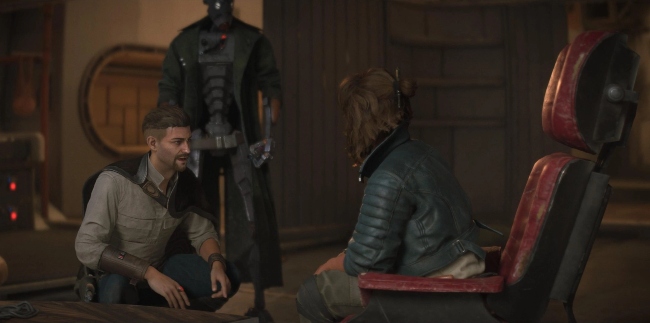
Jaylen and ND’s relationship stands in stark contrast to Halland Goth and TC-99 in Adam Christopher’s Master of Evil. Halland acquires TC-99 to help treat the symptoms of Kangly’s syndrome, a painful condition that’s killing him. He also manumits TC-99, “freeing the droid from programmed service and allowing him to be his own sentient being.” TC-99, then, has free will, and so stays with Halland out of genuine concern for his well-being. Halland refers to TC-99 on multiple occasions as his friend, and vice-versa.3 And while ND was “probably the closest thing Jaylen had to a friend,” by manipulating him and robbing him of his autonomy, Jaylen fails to be a true friend to ND.4
Droids in Star Wars are mostly relegated to supporting roles — always the bridesmaid, never the bride. There are exceptions, of course, stories where droids function more like main characters: the first act of A New Hope, the D-Squad arc of The Clone Wars, and now Low Red Moon. Compared to a movie or TV show, a book offers the opportunity to really inhabit a character, which makes it an ideal medium for developing a complex droid character like ND-5. I want to focus on two aspects of ND in particular, since they speak to nuances around writing droid characters: gender and neurodivergence.
When ND-5 first speaks to Jaylen on Gus Treta, the book describes ND’s vocabulator as “presenting a male tone.”5 This line jumped out at me. In Science Robotics, Robin Murphy writes that “[p]eople anthropomorphize robots, which includes presuming gender, even if the robots are not human-like or zoomorphic.”6 Fictional robots are disproportionately male, even when the plot doesn’t require them to be a specific gender. Robot gendering, in both fiction and real life, tends to reinforce gender norms. It’s no coincidence, for example, that virtually all digital assistants, like Siri and Alexa, are given conventionally feminine voices.
I’ve long been fascinated by the gendering of droids — both that droids have genders and how they acquire their genders — since it speaks to what gender is, and isn’t. Like real-world robots, Star Wars droids lack biological markers that have traditionally been used to ascribe gender identity — they don’t have reproductive organs or chromosomes. Occasionally droids will have morphologies that are suggestive of a particular gender — the BD-3000 luxury droids from The Clone Wars “look like” women — but not always. Consider, for example, R2 or BB units.
On what basis then do we refer to, say, C-3PO as he and TC-14 as she? Ideally, the droids themselves would get a say, though to my knowledge there’s no Star Wars story in which a droid grapples with their gender identity. It may partially be a reflection of the real-world actor who portrays the droid — Anthony Daniels is a man, thus C-3PO is male. As with ND-5, we might appeal to one or more attributes: whether their voice is high or low, their body type — the BD-3000s are outfitted with breasts — or even color. (Part of why the astromech R2-KT is female, aside from being inspired by a real-life little girl, is that she’s pink.) Consider FLO, the droid who works at Dexter Jettster’s diner. FLO’s voice is of a higher register, she has a petite form, and, as a server, she has a traditionally feminized job — all of these factor into her gender identity. BB-8 is another fascinating case study. A 2015 article on Screen Crush from before the release of The Force Awakens noted that BB-8 was variously referred to as he and she in development and quotes creature shop head Neal Scanlon as saying, “BB-8 was female in our eyes. And then she became male. And that’s all part of the evolution, not only visually, but in the way they move, how they hold themselves.”
All of this is to say that droids aren’t a gender so much as they perform one. Judith Butler famously argued that “gender is in no way a stable identity or locus of agency from which various acts proceed; rather, it is an identity tenuously constituted in time — an identity instituted through a stylized repetition of acts,” that “gender is instituted through the stylization of the body and, hence, must be understood as the mundane way in which bodily gestures, movements, and enactments of various kinds constitute the illusion of an abiding gendered self.”7 If droids perform their gender, then maybe we do too.
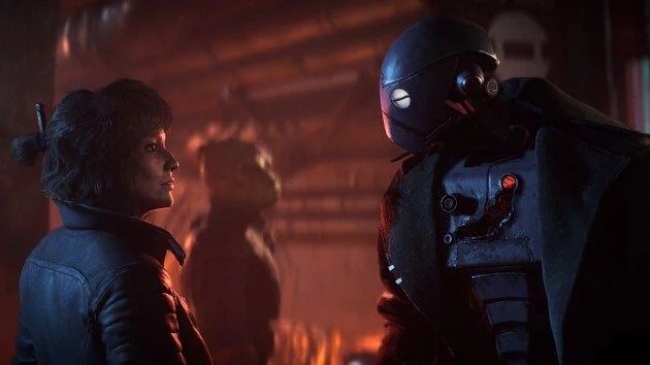
The ND-centric chapters of Low Red Moon help us to appreciate how ND-5 interacts with others and processes the world around him. Many of ND-5’s thoughts, behaviors, and attitudes are suggestive of neurodivergence, particularly autism. I was diagnosed with autism last year, far later in life than was good for me. Since then, I’ve become more attentive to how it manifests not only in myself, but also in other people, including fictional characters. The Diagnostic and Statistical Manual of Mental Disorders classifies autism as a neurodevelopmental disorder characterized by “[p]ersistent deficits in social communication and social interaction across multiple contexts” and “[r]estricted, repetitive patterns of behavior, interests, or activities[.]”8 Erin Felepchuk observes that “[m]achine metaphors are peppered throughout the clinical history of autism, particularly taking root in early associations of autism with coldness, emptiness, and detachment.”9 This association has extended into popular culture, where autistic characters have often been portrayed as robot-like, and robot characters have often been portrayed as autistic.
Consider this scene from Low Red Moon, where ND is trying to obtain information about a target from a government office:
The clerk, a Gran female, tilts her head and then says, “Number confirmation, please.”
“My designation is Jay-Ex-Three-Nine-Four-En-Dee—”
“No, your number,” she says with a heavy sigh.
“That is my designation as assigned by my manufacturer at Baktoid Combat Automata.”
“Blasted droids,” she says at a volume too low for a conversational exchange, then returns to her normal tone. “Take a number.”
It appears that everyone in this building speaks with a significant lack of specificity. If I were capable of being infuriated, this would likely trigger that emotion. “Take it where?”10
ND’s conversation with the Gran clerk illustrates challenges that many autistic people face in social situations. Like ND, those of us with autism often find ourselves frustrated when parents, friends, partners, coworkers, or authority figures use vague language or provide unclear instructions. Sometimes I’ve felt like people expect me to read their minds rather than them just telling me what they want or need from me. Some of us may also struggle with idioms like “take a number,” interpreting them literally rather than figuratively, or may miss when someone is joking, being sarcastic, or flirting. When Lorel Amberdine, a slicer who accompanies Jaylen and ND on a job, tells ND “don’t be a stranger,” he replies, “I’m not a stranger to you. We just worked together.”11
In another scene, Lorel attempts to make small talk with ND, remarking that he must be wearing a coat to cover up his chest scar, and he responds tersely:
“This coat serves multiple purposes,” I say. The words come out fast, without taking up additional processing — representing a strategic decision to end this conversation.
“Okay,” she says slowly. So slow that the word draws out, and she takes a break from her datapad to look at me. I do not turn my head, though my peripheral field of view catches this, along with the squint on her face.
I have been rude. Being rude can disrupt human emotions and thus jeopardize the mission, which will then put my priority goals at risk.
I must take care of this in the most appropriate fashion.12
Conversational give-and-take is difficult for a lot of autistic people. We may have a hard time initiating or sustaining small talk, or appreciating why it’s important. Lorel’s desire to make small talk puzzles ND, who says, “I cannot tell if that is a nervous trait of hers or if she is naturally gregarious.”13 Like many with autism, I sometimes have to mentally rehearse what I’m going to say before entering a conversation. Some psychologists speculate that autistic people struggle with theory of mind, which is the ability to imagine the mental states of other people, and to recognize that their mental states may be different from your own. Theory of mind is crucial for anticipating how one’s words and actions may affect other people. As a consequence, we may struggle with interpreting other people’s words, tone, or body language, or our own words, tone, or body language may not fit the situation. (On multiple occasions I’ve had the involuntary urge to smile when someone’s upset and I have to consciously tell myself not to do that.) We may also inadvertently say or do something that hurts someone else’s feelings because our minds don’t consider those words or actions as hurtful. ND is eager to end the small talk with Lorel so he can focus on the mission, and he does so by using an inappropriately brusk tone, which, in turn, upsets Lorel.
ND-5 isn’t the only example of an autistically-coded droid in Star Wars, though not all Star Wars droid necessarily fall on the spectrum: C-3PO, I would argue, certainly fits the bill, but Chopper, for one, doesn’t. The autism-as-machine trope has historically been problematic because it perpetuates a stereotype of autistic people as less than human, as incapable of “real” feelings. Fortunately, I don’t think that Mike Chen’s portrayal of ND-5 falls into that trap. For one, the book demonstrates that ND is capable of learning and growing. After his outburst at Lorel, ND recognizes that he’s done wrong and apologizes. When she gives him the name of a droidsmith who might be able to remove the override chip, he’s clearly touched, observing that “[t]his gesture offers no personal benefit to Lorel” and that “[s]he appears to be doing it out of a mixture of concern and generosity.” Lorel remarks that “the more droids experience, the more they can draw from to make decisions,” which means that “your parameters aren’t just binary[.]” ND notes that “accumulated memories and learned experiences” have created “new logic patterns,” making him more than his programming. Towards the end of the book, Jaylen notices that “somewhere in ND-5’s programming, his confidence in his own ideas — however a droid might define that notion — was growing.”14
ND also cares about the people around him, including Jaylen (undeservedly), Lorel, and, later, Kay Vess. Low Red Moon concludes with a poignant epilogue that takes place after the events of Outlaws. ND, now free, has chosen to stay with Kay aboard her ship, the Trailblazer. He describes bonding with Kay’s pet merqaal Nix and learning his mannerisms, saying, “I have grasped the meaning of things like apologies and gifts.” He also watches over Kay. When she rests her feet on the Trailblazer’s console while sleeping, he puts them down so the ship doesn’t accidentally leave hyperspace. Later he notices that she’s put them back up, but this time, “I decide to let her rest.”15
ND-5 is many things to many people. A sex symbol. An autistic king. A trans and non-binary icon. Like many characters we’ve gotten in Star Wars in recent years, ND-5 is a testament to the joy of feeling seen and validated by the media you watch, read, and listen to. ND-5 also represents a massive leap forward for droid storytelling in Star Wars. Perhaps someday Lucasfilm will announce a book or a show or a movie with a droid as the lead protagonist. Low Red Moon’s compelling and multidimensional portrayal of ND-5 has made the odds that much better.
- Mike Chen, Star Wars Outlaws: Low Red Moon. (New York, NY: Random House Worlds, 2026), 108, 113, 138, 274, 345, 348. ↩︎
- Chen, Low Red Moon, 274, 326. ↩︎
- Adam Christopher, Master of Evil. (New York, NY: Random House Worlds, 2025), 51, 249, 316, 328. ↩︎
- Chen, Low Red Moon, 274. ↩︎
- Chen, Low Red Moon, 60. ↩︎
- Robin R. Murphy, “We cannot escape gendering robots,” Science Robotics, 8 (2023). ↩︎
- Judith Butler, “Performative Acts and Gender Constitution: An Essay in Phenomenology and Feminist Theory,” Theatre Journal, 40 no. 4 (1988): 519. ↩︎
- American Psychiatric Association, Diagnostic and Statistical Manual of Mental Disorders, Fifth Edition. (Arlington, VA: American Psychiatric Association, 2013), 50. ↩︎
- Erin Felepchuk, “Autism-as-Machine Metaphors in Film and Television Sound,” Ought: The Journal of Autistic Culture, 2 no. 2 (2021): 46. ↩︎
- Chen, Low Red Moon, 226. ↩︎
- Chen, Low Red Moon, 202. ↩︎
- Chen, Low Red Moon, 167-168. ↩︎
- Chen, Low Red Moon, 166. ↩︎
- Chen, Low Red Moon, 170, 171, 214, 306. ↩︎
- Chen, Low Red Moon, 358-359. ↩︎

