During an audience Q&A at the ATX Film Festival, Tony Gilroy revealed that he named B2EMO, the Andor family droid, after his son’s corgi, Bemo. Ever since season one, fans have pointed out how B2EMO resembles the old family dog, from his unwavering loyalty to Maarva to his bed-shaped charging station. The closing minutes of “Jedha, Kyber, Erso” even confirm that B2 lived out his days on a farm upstate.
Droids occupy a complicated status in the Star Wars galaxy. As with much else, A New Hope laid the foundation. C-3PO and R2-D2 are the first speaking characters to whom we’re introduced. They are also, for all intents and purposes, the main characters of the film’s first act.
They are also bought and sold. As subsequent installments in the franchise demonstrate, chattel slavery in Star Wars is certainly not limited to droids. But in the context of A New Hope, this does distinguish them from the film’s organic characters. As does the fact that they’re not allowed in Chalmun’s cantina. “We don’t serve their kind here,” Wuher, the cantina’s bartender, barks at Luke. “They’ll have to wait outside. We don’t want them here.”
In an August 1978 review of A New Hope in Jump Cut: A Review of Contemporary Media, Dan Rubey argued that the film’s portrayal of droids had racist undertones, writing that the droids “do the real work of this society but are discriminated against.” “The point here is not that the treatment of robots in STAR WARS is racist,” Rubey continued, “but that the film makes use of and supports racist habits of thought when it divides its characters up into hierarchical levels based on their physical attributes.” More recently, Nicholas Wanberg contended that 3PO and R2 were racialized by virtue of their subservience, writing that “[t]he droids act as servants for humans simply because that is what droids do, which is taken for granted by their human masters and the droids themselves. This assumption has a strong resonance with many racist positions.”
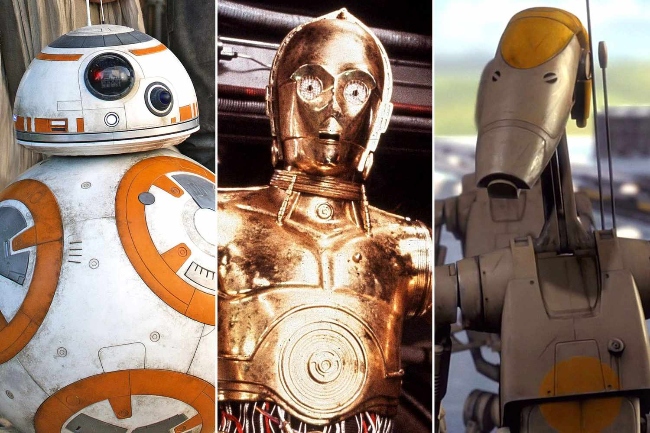
While people have compared droids to (racial) minorities almost as long as Star Wars itself has existed, I think it’s an imperfect analogy. I don’t deny the parallels identified by those like Rubey and Wanberg, and no doubt George Lucas intended audiences to draw at least some of those conclusions. But I argue that there’s a better real-world analog for the moral status of Star Wars droids: non-human animals. Moreover, I believe that animal rights philosophy offers a framework with which to build a case for droid rights.
A key advantage of the droids-as-animals paradigm is that it allows us to interrogate two distinct hierarchies related to droids:
1. Hierarchies among different kinds of droids.
and
2. Hierarchies between droids and organics.
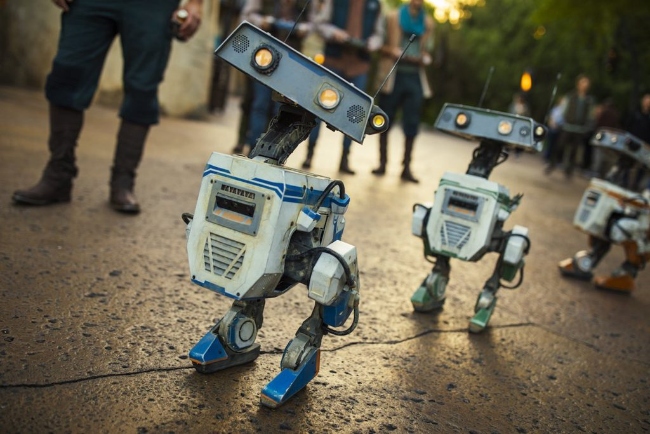
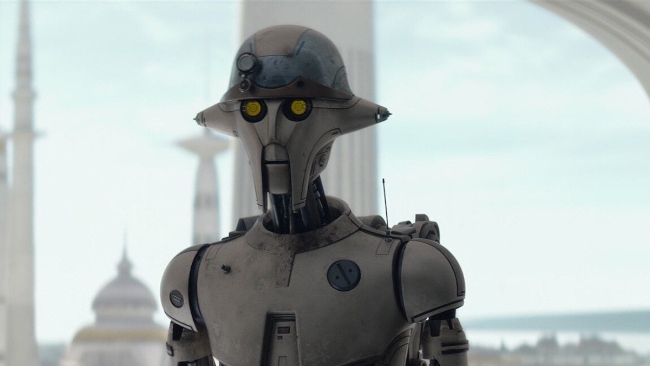
Star Wars droids are not created equal. Rather, the lives of some droids are more valuable — both to in-universe characters and to audiences — than others. Star Wars droids fall into two broad categories. On the one hand, there are the named droids who function as either main or secondary characters and who are companions of organic characters: C-3PO, R2-D2, BB-8, BD-1, to name just a few. Then there are the anonymous droids whose lives are far more instrumental: the legions of B1 battle droids who wage war on behalf of the Confederacy of Independent Systems, Andor’s stairs droid, The Acolyte’s chair droids. These categories are not necessarily fixed: K-2SO was a garden-variety KX droid before the Rebellion reprogrammed him. Generally speaking, though, droids in the former category elicit a degree of affection and attachment that droids in the latter category do not.
Animal rights philosophers have observed similar attitudes regarding non-human animals. In her book Why We Love Dogs, Eat Pigs, and Wear Cows, Dr. Melanie Joy defined carnism as “the belief system in which eating certain animals is considered ethical and appropriate.” Many cultures and traditions have rules and norms around the consumption of animals: Jainism, for example, forbids eating any animals whatsoever, whereas Judaism and Islam only prohibit eating the meat of certain animals. Most people in, say, the United States have no qualms about eating cows, but would recoil if served a plate of dog. “We love dogs and eat cows,” Dr. Joy wrote, “not because dogs and cows are fundamentally different — cows, like dogs, have feelings, preferences, and consciousness — but because our perception of them is different.” When it comes to dogs, we’re acculturated to think of and interact with them as friends or family members. By contrast, unless you live or work on a farm, you probably only cross paths with a cow when it’s already been slaughtered and processed into meat.
According to Dr. Joy, carnism is reinforced through a system of beliefs, attitudes, and psychological defense mechanisms. We associate the animals we consume with negative traits — dumb, dirty, ugly — and companion animals with positive traits: cute, loyal, friendly. We treat meat eating as “natural” and “the way things are.” And we avoid photos or videos that show the often abysmal conditions in which animals living in factory farms are raised. (Which, incidentally, are often captured illegally, thanks to laws that shield factory farms from public scrutiny.)

Carnism is a useful framework because it captures the inconsistent moral attitudes that many of us have towards animals. We inflict tremendous suffering on cows, pigs, and chickens while sparing cats and dogs not because of any objective differences between the two groups of animals, but because of subjective attitudes and preferences. In the Star Wars galaxy, droids like 3PO and R2 are treated like cats and dogs (i.e., as companions), while battle droids, vulture droids, KX droids, and the like are treated like pigs and cows (i.e., as fodder). But just as we should regard a cow’s life as valuable as a dog’s, so too should we not sort droids into morally arbitrary boxes.
Undoing carnism and establishing a baseline equality among animals is a prelude to challenging the moral hierarchies that privilege human lives over non-human lives. In his landmark book Animal Liberation, Peter Singer popularized the term speciesism to describe “prejudice or attitude of bias in favor of the interests of members of one’s own species and against those of members of other species.” He argued that the “principle of equality,” whereby “the interests of every being affected by an action are to be taken into account and given the same weight as the like interests of any other being,” ought to be expanded to encompass humans and non-human animals alike. Singer identified the “capacity for suffering and enjoyment” as “a prerequisite for having interests at all,” and since most animals possess such a capacity, we have a moral obligation to consider their interests before, saying, killing them for meat or experimenting on them.¹
Can droids in Star Wars suffer? Undoubtedly so. Star Wars gives us many such examples. In Return of the Jedi, we see 8D8 torture a Gonk droid by pressing hot irons onto its feet — the droid kicks its legs and cries out “No! No! No!” as the irons descend, then lets out a scream when they press down. In the Star Wars Rebels episode “Hera’s Heroes,” Chopper clearly experiences post-traumatic stress upon seeing the Y-Wing in which he crashed onto the Syndulla family compound. The BX droid ND-5 also displays symptoms of post-traumatic stress in Star Wars Outlaws. Andor offers one of the most stirring portrayals of droid suffering — the audience learns of Maarva’s passing (literally) through B2EMO’s eyes. B2 is visibly shaking, and when Brasso offers him a moment to be alone, he replies, “I don’t want to be alone. I want Maarva.” By the same token, we also see that droids can be happy, as when a freshly-repaired R2 appears at the end of A New Hope. Droids, then, are surely subject to Singer’s equality principle.
Singer qualified his stance by noting that equal consideration does not mean equal treatment. By virtue of their physiology, most humans have a greater capacity for enjoyment/suffering than many animals. Accordingly, it is not wrong to consider experimenting on a human morally worse than experimenting on, say, a rabbit. But Singer’s equality principle does require us to pause and question whether we ought to experiment on the rabbit at all. Singer took his equality principle one step further to argue that we also ought to give equal, if not greater, moral consideration to some animals as we do to some humans. To continue with the thought experiment, if we determined that it was morally permissible to experiment on the rabbit, then, by Singer’s reckoning, it should also be permissible to experiment on a human with comparable capacities for enjoyment/suffering. Unsurprisingly, this challenges many of our hard-wired moral intuitions about the value of human life. Singer, however, would argue that those intuitions reflect a bias in favor of human life that is often rooted in little more than speciesism.²
If we apply Singer’s equality principle to droids in Star Wars, we would similarly conclude that, when confronted with the moral choice, it’s often OK to privilege the happiness and welfare of an organic being over a droid. That said, because droids possess the capacity to enjoy and to suffer, we ought to consider their interests as morally equivalent to any organic beings with similar capacities. We should not discount their well-being merely because they are machines.
Peter Singer approaches animal rights from the utilitarian tradition. In its simplest form, utilitarianism holds that the moral rightness or wrongness of an action depends on the amount of utility (i.e., happiness) that it produces. (Or, conversely, the amount of suffering that it inflicts.) Animal Liberation quotes Jeremy Bentham, the founding father of utilitarianism, who wrote of animals, “the question is not, Can they reason? nor, Can they talk? but, Can they suffer?”
Tom Regan rejected the utilitarian approach, but nevertheless reached conclusions similar to Singer. “Utilitarianism,” he wrote, “has no room for the equal rights of different individuals because it has no room for their equal inherent value or worth.” He believed that utilitarianism elevated “the satisfaction of an individual’s interests” above “the individual whose interests they are.” This, in turn, produced unsavory outcomes, such as the notion that we can sometimes sacrifice the lives of others for the sake of maximizing overall utility. Regan instead adopted what he called the rights view, according to which “all have inherent value, all possess it equally, and all have an equal right to be treated with respect, to be treated in ways that do not reduce them to the status of things, as if they existed as resources for others.”
Regan argued that the rights view extended to include non-human animals. True, non-human animals may not possess cognitive functions on par with most humans (e.g., higher-level reasoning, the capacity to produce art or literature, etc.). But it is also true that some humans also lack these abilities — infants, for example, or those with severe intellectual disabilities, or those in long term comas. It would, however, be morally repugnant to conclude that those lives have less moral worth than other human lives. Accordingly, we should recognize that animal life, too, is valuable in and of itself. Humans and non-human animals are equally “subjects of a life.” To be a subject of a life is to be “a conscious creature having an individual welfare that has importance to us whatever our usefulness to others”:
We want and prefer things, believe and feel things, recall and expect things. And all these dimensions of our life, including our pleasure and pain, our enjoyment and suffering, our satisfaction and frustration, our continued existence or our untimely death — all make a difference to the quality of our life as lived, as experienced, by us as individuals.
Regan takes an arguably stronger position than Singer, for he contends not only that animal life has inherent value, but also that its value is on par with human life, declaring that inherent value “belongs equally to those who are the experiencing subjects of a life.”
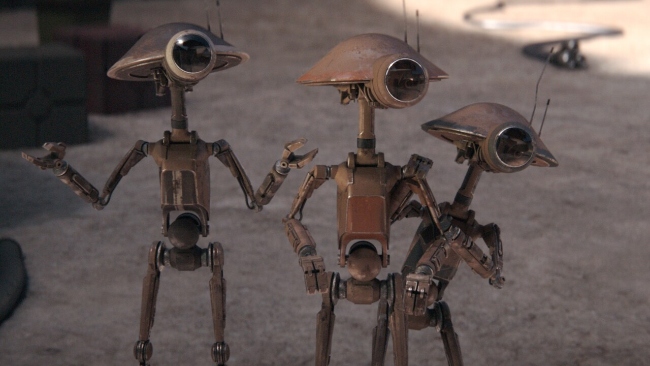
Are droids subjects of a life? As with droid suffering, I think Star Wars speaks for itself. One of my favorite stories from the From A Certain Point of View anthologies is “The Key to Remembering” by Olivia Chadha, which follows EV-9D9, Jabba the Hutt’s torture droid from Return of the Jedi. In the story, EV-9D9 is on a mission to uncover “[t]he anomaly that could show her the path beyond her programming.” By studying the droids brought to Jabba’s palace, she hoped to learn how she might gain free will. Thanks to R2, she learns that the answer lay in memory: those droids whose memories were wiped more frequently were more pliant, while those who had more memories — and, by extension, more relationships with others — resisted. On acquiring this insight, she installs a jamming device to prevent her memory from being wiped. “The Key to Remembering” is a poignant testament to the capacity of droids to define the course of their own lives. In another instance of droid autonomy, the super tactical droid Kalani disregarded the shutdown command at the end of the Clone Wars, reasoning that it was a Republic trick, and remained a Separatist holdout on the planet Agamar. The Mandalorian episode “Guns for Hire” features an all-droid bar called “The Resistor” on the planet Plazir-15. Droids even formed criminal enterprises like the Droid Gotra, the Vanguard Axis, and the Droid Crush Pirates of Bestoon. Clearly, Star Wars droids can live lives as full and messy as any organic. We ought, then, to consider droids as subjects of a life, with inherent value equal to organics.
I want to briefly consider one potential objection to the droids-as-animals model proposed here. While it’s true that the social and moral status of droids may resemble that of non-human animals, the two are also different in an important way: animals are flesh-and-blood, while droids are machines. It might seem like droids feel pleasure and pain and have hopes and dreams, but ultimately that’s just a function of programming. They’re not really having these experiences.
While I concede the distinction, I’m less sure that it’s a morally meaningful one. From this perspective, droids are no different from, say, a toaster. But they are different. Droids occupy a liminal space between pure and simple machines and sentient organics. Even if we concede that droids aren’t sentient (and I don’t know that I want to), they’re certainly close enough that we ought to extend them certain moral rights and protections. Moreover, I’m not sure that reducing droid experiences to mere programming is the slam dunk that it appears to be. After all, human and animal experiences are just electrochemical signals transported through nervous systems. Some research in neuroscience suggests that brain activity occurs before you consciously decide to take an action, thus potentially muddying the waters around free will, though the underlying science and its philosophical implications are contested.³ Does any of this reduce the moral weight of our choices and experiences or make them less “real”? I wouldn’t say so. If we want to argue that certain living beings have souls while all non-living beings don’t, that’s one thing. But since I personally don’t believe in a non-corporeal soul, I don’t find this a useful line of inquiry.
Ultimately, both Singer’s utilitarian and Regan’s rights-based approaches to animal rights, when applied to droids in Star Wars, point to droid rights and droid equality. Solo, via L3-37, turned droid rights into something of a punchline. This is not unlike the eye-rolling with which animal rights activism is often greeted in our own galaxy. (PETA makes it very tempting to throw the baby out with the bathwater.) But as we’ve seen here, there are good reasons for extending rights to animals, while our reasons for not doing so tend to be rooted either in the privileging of arbitrary characteristics (e.g., species membership) or in criteria for moral worth that, if applied dispassionately, would exclude certain classes of humans from our sphere of moral concern. The same goes for droid rights.
Taking droid rights and animal rights seriously would demand radical changes in both the Star Wars galaxy and our own, respectively. Droids could no longer be treated merely as extensions of an organic’s will. The days of restraining bolts would be over. Droids would likely even be entitled to the franchise and representation. Meanwhile, the animal rights paradigm affords little room for most, if not all, of the harm that humans inflict on non-human animals on a daily basis. At the very least, most in the affluent West, who have benefitted generously from factory farming, ought to become vegetarians, if not vegans. Any consumption of animal products would have to look radically different from how it does now, as would any sort of animal experimentation. Animal-based sports would surely have to go.
It’s easy to discount ethical paradigms that look ridiculous at first glance, or that challenge long-held assumptions, or whose implementation would require a fundamental transformation of society. Discomfort and ridicule are the easy ways out. Many of the inalienable rights that we assert today would have been outlandish in civilizations past, and many behaviors that we consider immoral once enjoyed greater acceptance. Perhaps, decades if not centuries after The Rise of Skywalker, organics will shudder to think that they once wiped the minds of droids as a matter of course. Hopefully it won’t take us that long to feel the same about the slaughterhouse.
1. For the sake of brevity, I take it for granted that readers accept the premise that animals can experience pleasure and pain. If, however, any readers question this, here is a place to start.
2. I would be remiss not to acknowledge that Singer’s ethics — specifically, his views on the permissibility of assisted suicide — have made him a controversial figure, particularly within the disability rights movement. It is beyond the scope of this article to review and consider that controversy here. For those interested, here is one perspective.
3. For an overview, go here.


One thought on “Not Just Programming: Why Droids Deserve Moral Consideration”