The seventh and eighth episodes of Maul: Shadow Lord, entitled “Call to Oblivion” and “The Creeping Fear,” take the titular character, Maul (formerly Darth), and shift his conflict from fighting external enemies such as the Empire and its Inquisitors to an internal struggle. Maul is no longer just fighting enemies—he is fighting himself. In that, Maul’s story becomes a study of how trauma, identity, and the need for control collide. Moreover, these episodes become a statement on how his refusal to release the past shapes both his power and his limitations.
Prior to these episodes, Maul’s main motivations were external, in that he was always fighting an enemy. First, it was Kenobi. For a moment, it was going to be Anakin Skywalker, but it turned out to be Ahsoka Tano. Now, in Shadow Lord, his primary antagonists are the Empire, its Emperor, and the Inquisitors sent to hunt him. He was always fighting something or someone else, so he never had to deal with the trauma of his history—save for wanting Kenobi to suffer as he did when he was cut in half and left living in the squalor of a trash planet with spider legs.
Fighting external enemies is easy for Maul, as that is what he was trained by Darth Sidious to do. During his upbringing, that enemy was the Jedi, but the physical skills he learned to defeat them are easily transferable to the next enemy, and the next after that. What is hard is not fighting someone or something else—it is fighting oneself. After his fight with the Inquisitors, that is exactly where Maul finds himself.
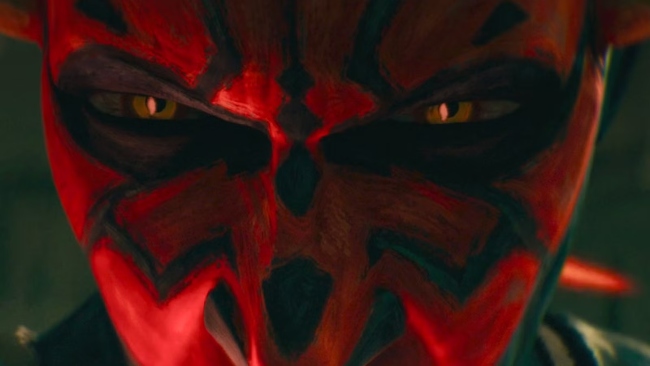
As he travels through the bowels of Janix, with a dust storm reminiscent of Tatooine in The Phantom Menace blowing against him, Maul sees his history unfolding before his very eyes. He sees his brother, Savage Opress, begging him not to leave with Sidious. He sees his torture at the hands of his master. He sees his brother’s death at the end of his master’s blade. He sees Kenobi striking him down, his life with spider legs, and more. The Force takes the trauma that Maul buried for so long and makes it external, because that is the language Maul understands.
In doing so, the Force asks Maul an important question—are you going to change, or are you going to stay the same? This is an opportunity for Maul to actually deal with his trauma, reshape his identity, and let go of his need for power and control. It is an opportunity for Maul to become someone and something new, if he takes it.
Unfortunately, that is just not who Maul is. Maul is Sisyphus, the tragic figure forced to repeatedly make the same mistakes over and over again. When Maul’s visions end, he could take a different path, yet he doubles down on his desire for revenge against Sidious for what was done to him. This desire gives him the power to rise up, push through the storm, and return to his gang to lead them forward. By all appearances, Maul is Sisyphusing once again.
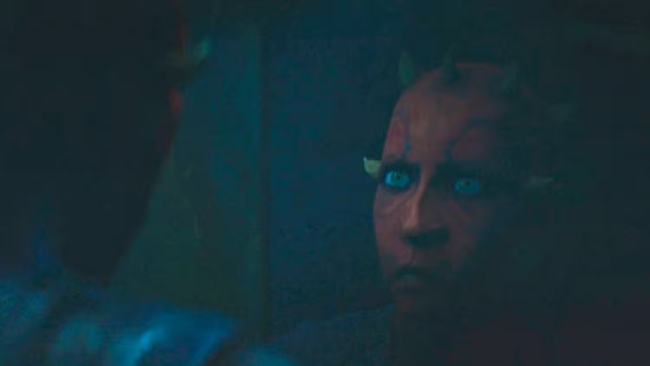
However, there is a chance that Maul could be beginning a different path. At the end of his visions, Maul looks into a puddle and sees himself as a child reflected back at him, and a tear runs down the face of the once unbreakable villain. In this moment, it seems that Maul’s internal motivation begins to change. He begins to understand why he wants revenge on Sidious—so that the Sith can never do to someone else what they did to him.
The challenge moving forward will be whether Maul is able to recognize and embrace this shift in character. If he is, he may have a chance to connect with Devon, the Jedi apprentice he is trying to recruit in his efforts to take down the Empire, on a deeper level. If he is not, however, he will once again fall into the Sisyphean trap he always does.
Looking ahead to the last two episodes of this season and what the next season of Shadow Lord will bring, this will be the most important factor in Maul’s development as a character. If he continues to cling to the past, he will remain limited in who he can become, trapped by the chains he has bound himself with. If he is able to let go, however, he may finally become something new and different. What that looks like is hard to predict, given Maul’s tragic history and where his story ends in Rebels, but that is the nature of good storytelling. For once, Maul’s character may be less about brute force and more about the subtle internal shifts that make characters relatable on a visceral level.


