Andor is a human story: it’s about love and loss and rage and resistance and the price we pay to make a better world, one that we ourselves may never get to inhabit.
It’s also a human story.
There are aliens in Andor. Brothers Benthic and Edrio return as part of Saw’s Partisans, as does Moroff. Season two has provided a new addition to my personal pantheon of Star Wars Weird Little Guys™: the Oathkeeper, who presides over the Senate. (At the time of writing, Wookieepedia identifies the Oathkeeper as belonging to an “unidentified wattled species.”) But Andor’s aliens are ancillary characters. Our leads — Cassian, Bix, Luthen, Mon, Saw — are all humans, and the environments in which we see them are also predominantly human: Ferrix, Aldhani, Narkina 5, Chandrila, Coruscant, and Ghorman.
The Ghorman Massacre was the catalyst for both Mon Mothma leaving the Imperial Senate as well as the public coming-out of the Rebel Alliance. Thanks to Andor season 2, we now know more about the Empire’s interest in Ghorman, the events that precipitated the massacre, the key players involved, and the fallout. And perhaps most importantly, we actually see the Empire perpetrate the massacre.
Whether Tony Gilroy intended it or not, I contend that it matters that the last straw for Mon Mothma, a human senator, took the form of a massacre of humans. Tony Gilroy has talked about how historical events informed Andor’s storytelling. But, as Star Wars has done since 1977, Andor also reflects the here and now. In that vein, the human-ness of Andor and the atrocities that it depicts shouldn’t escape our attention. It speaks to whose suffering we empathize with and whose we don’t, and how moralities that discount tragedies that happen “over there” to “those people” can doom us all.

In his magisterial book The Rise and Fall of the Galactic Empire, Dr. Chris Kempshall dedicates an entire chapter to the Empire’s atrocities and genocides. It’s not an exaggeration to say that the Galactic Empire was birthed in genocide. After all, it was the genocide of the Jedi Order through Order 66 that eliminated the last major obstacle to Palpatine reorganizing the Republic into the Empire. What stands out in Dr. Kempshall’s chapter on Imperial atrocities and genocides is how many of the Empire’s crimes against “humanity” were committed against non-human alien populations: the forced relocation of the Kaminoans, the enslavement of the Wookiees, the scorched-earth campaigns on Ryloth and Mimban, and, of course, the genocide of both the Lasat and the Geonosians, to name a few. Season 1 of Andor introduced us to the Dizonites of Dizon Fray, who were exterminated after resisting the construction of an Imperial refueling center. Recordings of their dying screams were subsequently used by Dr. Gorst on Bix Caleen. (Gorst got a taste of his own medicine just before he was killed in “What A Festive Evening.”)
The Dizonites illustrate how atrocities against alien populations paved the way for later Imperial crimes, some directed towards humans. In the case of the Dizonites, the Empire leveraged their extermination to produce new instruments of torture. In other instances, the Empire used mass violence to obtain natural resources or slave labor that, in turn, fed the Imperial war machine.
Aliens bore the brunt of Imperial atrocities in part because, as Dr. Kempshall’s chapter on prejudice and discrimination details, the Empire promoted hierarchies that, among other things, established humans as superior to non-humans. This didn’t mean that aliens were utterly ostracized from Imperial society — after all, “Welcome to the Rebellion” shows us several alien Senators regurgitating Imperial propaganda about Ghorman. But aliens were, without question, second-class. (In another example of Star Wars mirroring the real world, in The Mask of Fear, a member of the pro-Imperial “4040s” remarks that the Empire couldn’t be anti-alien because the Chagrian Mas Amedda was the Grand Vizier.) This didn’t come out of nowhere. Rather, as Dr. Kempshall writes, “[h]umans are particularly well-represented within the Core Worlds and, as a result, were already in possession of a great deal of the galaxy’s wealth and power even before the rise of the Empire.” In other words, the Empire reinforced what already amounted to a galactic status quo.
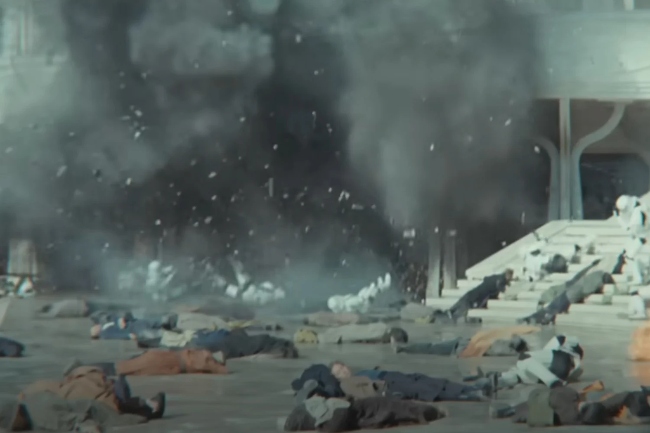
We cannot understand the Ghorman Massacre and the response to it by characters like Mon Mothma outside of the context of both the lengthy record of Imperial anti-alien atrocities and the speciesism of the Empire (and its predecessor, the Republic). Despite the horrors inflicted on populations like the Kaminoans, the Wookiees, and the Geonosians, it took the indiscriminate killing of the human Ghor for Mon Mothma to decide that she’d had enough.
You can object that I’m being unfair to Mon Mothma. After all, the Ghorman Massacre resonated so powerfully in part because it was so public — tensions had been escalating for several years, both the Empire and the nascent Rebellion dedicated significant resources to the conflict, and there were throngs of reporters on the ground in the run-up to the massacre. Conversely, many of the Empire’s crimes against aliens, like the Geonosian genocide, took place in the shadows.
But I don’t want to let Mon — nor other human Rebels, for that matter — off so easily. Yes, some anti-alien atrocities took place away from the cameras or prying Senators, but not all. In the Bad Batch episode “Truth and Consequences,” footage of the destruction of Tipoca City is played on the Senate floor. Dr. Kempshall describes the Imperial occupation of Kashyyyk as a “public affair designed to instill fear in populations that were closely loyal to the fallen Republic or were viewed by Imperial officials as liable to rebel.” “We had no idea” is a common refrain, but all too often there were in fact breadcrumbs for those willing to follow them.
But even when it comes to those atrocities about which less is known — Dr. Kempshall notes, for example, that “[d]etails regarding the events that led to the Siege of Lasan in 7 BBY remain sketchy” — the silences in the record speak loudly. The Empire’s speciesism meant that it was easy to overlook or ignore atrocities playing out on alien worlds, especially Outer Rim planets like Lasan and Geonosis, which lacked representation in the Senate. Human reporters weren’t rushing onto transports to get the latest on the plight of the Mimbanese or the Wookiees. As far as we know, no one asked questions about what happened to the Kaminoans after the destruction of Tipoca City.

As with all historical or contemporary events — whether in the Star Wars galaxy or our own — we can’t be monocausal. The Ghorman Massacre wasn’t important just because the Ghor were humans. Ghorman was more publicized than many of the Empire’s other atrocities. Moreover, the massacre took place at a moment when the Rebellion had matured to the point that it could afford to make itself public. There are always a constellation of factors that explain why certain things happen and others don’t, why this grabs our attention and that doesn’t.
But there’s no denying that, in the case of Ghorman, the human factor is one of the stars within that constellation, one that we ought to reckon with. As with so much else in Andor, it forces us to look in the mirror and to think about the real-world atrocities to which we pay attention and the ones to which we don’t, the victims with which we identify and the ones with which we don’t. Is it so implausible to think that Mon would — however unconsciously — relate more to a dying Ghor than a dying Geonosian, when so many in the United States, Canada, and Europe have an easier time showing solidarity with Ukrainians living under Russian occupation than with Palestinians living under Israeli apartheid?
In her speech before the Senate in “Welcome to the Rebellion,” Mon denounces Palpatine as “the monster who will come for us all soon enough.” The belief that the violence and repression done “over there” stays there is a potent narcotic. Yes, many alien species were targeted by the Empire. But the Empire’s thirst for blood eventually reached Ghorman and Mandalore and Alderaan. (These are, incidentally, also the genocides that Star Wars chooses to show onscreen. We know that the Geonosians were gassed and the Lasat ripped apart by T-7 ion disruptors, but we do not see it. Perhaps Star Wars’ creatives are making calculations about which atrocities will tug at our [human] heartstrings.)
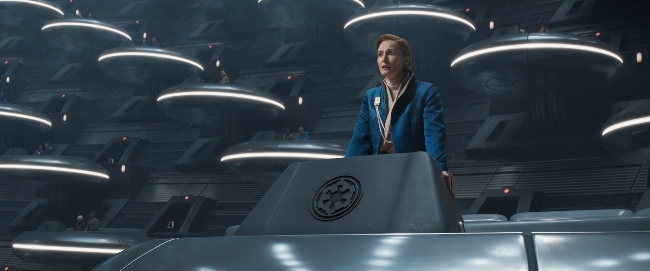
Violence inflicted on the periphery is all too often turned inward, onto the core, and those who ostensibly occupy positions of privilege can also be targeted in campaigns waged against the “other.” As I write this, the United States — along with a large share of the West — is the midst of an anti-trans panic, resulting in all manner of legislation, executive orders, and policies intended to push transgender people out of public life. But as it turns out, cisgender people are also getting swept up in the dragnet. The war against the trans community is rapidly evolving into a war against anyone who doesn’t fit narrow definitions of masculinity and femininity. Deportations of undocumented immigrants become deportations of legal residents which become (potentially) deportations of U.S. citizens. The monster will come for us all, indeed.
On August 22, 1939, Hitler delivered a speech to a group of German military commanders at his home in Obersalzberg. In it, he mused on the international reaction to Germany’s impending invasion of Poland, which took place one week after the speech:
Our strength lies in our quickness and in our brutality; Genghis Khan has sent millions of women and children into death knowingly and with a light heart. History sees in him only the great founder of States. As to what the weak Western European civilisation asserts about me, that is of no account. I have given the command and I shall shoot everyone who utters one word of criticism, for the goal to be obtained in the war is not that of reaching certain lines but of physically demolishing the opponent. And so for the present only in the East I have put my death-head formations’ in place with the command relentlessly and without compassion to send into death many women and children of Polish origin and language. Only thus we can gain the living space that we need. Who after all is today speaking about the destruction of the Armenians?
Hitler believed that the victims of the Armenian genocide were a forgotten people, and that the victims of his planned genocide would also be forgotten. He was wrong on both counts.
The Rise and Fall of the Galactic Empire is written as an in-universe history produced by Beaumont Kin in the aftermath of The Rise of Skywalker. That the Lasat and the Geonosians and the Wookiees and the Mimbanese figure so prominently offers some consolation that the crimes that the Empire committed against them and other alien populations were ultimately not swept under the rug, that the galaxy learned a measure of the truth of what the Empire did to them. The chapter on atrocities and genocides ends with a condemnation, and a call: “We should have done more. I should have done more. Never again. These events should haunt and motivate us forever.”
In the closing minutes of “Who Are You?,” Dreena broadcasts a plea to the galaxy: “If you can hear me, if you believe in truth, if you have any faith left in truth, please, please mark this message and pass it forward.” Mon heard, and she had the courage to call the Ghorman Massacre what it was — a genocide — and to name the person responsible: Emperor Palpatine. We owe the Ghormans of our galaxy that, too.
 CLASHING SABERS
This was so well written and thought provoking. I need to read Rise and Fall now.
LikeLike