I spent a lot of The High Republic struggling with Marchion Ro and the Nihil. I didn’t find them very interesting. Their motivations felt one-dimensional. Marchion Ro came across as every college libertarian who reads Atlas Shrugged and makes it their personality. They presented a host of technical problems for the Jedi — how to bring down the Stormwall, how to counteract the Nameless effect, how to stop the Blight — but I didn’t feel that they had anything compelling to say.
Phase II changed that. Phase II is where I well and truly hopped aboard The High Republic bandwagon. Arguably the biggest reason is the Path of the Open Hand, a cult whose mantra is “the Force will be free.”
As students of Star Wars lore, it is easy for us to dismiss the Path’s zero-sum view of the Force, whereby using the Force amounts to a “taking” that has to be compensated for elsewhere. As Han Solo put it, that’s not how the Force works. But this perspective on the Force does present a philosophical challenge to the Jedi Order, one that the Nihil never really offer.
In the classic Star Wars tradition of iterative storytelling, the introduction of the Path as the predecessor to the Nihil lends depth to an otherwise superficial band of marauders. On first blush, the Path’s goal of freeing the Force seems far removed from the ambitions of the Nihil. But this distance — born not just of ideology, but also of time — reveals that Marchion’s crusade is not merely against the Jedi or the Republic. In the course of transforming the Nihil into an instrument of his will, Marchion also attempts to free himself from his family’s past, and as such declares war on history itself.

Before proceeding, we need to answer a conceptual question: what is history? While history, as a discipline, concerns itself with the past, “history” is not the same thing as “the past.” The historian Edward Hallett Carr illustrated the difference by observing that Julius Caesar crossing the Rubicon in 49 BCE is a historical fact, while the millions of people who crossed the Rubicon before and after Caesar are just facts about the past.
According to Carr, the difference between a historical fact and a fact about the past “rests not on any quality in the facts themselves, but on an a priori decision of the historian…History, then, is a continuous process of interaction between the historian and his facts, an unending dialogue between the present and the past.”1
In a very real sense, history is manufactured: someone makes a case for why a fact — or set of facts — about the past are important, and if enough people agree, those facts become part of history. Although the full argument for this is beyond the scope of this article, I think there is a strong case for treating the Star Wars canon as a history, with the books, comics, movies, television shows, and other media constituting a chronicle of historical facts.2
One of my favorite commentaries on history comes from the opening lines of The Eighteenth Brumaire of Louis Napoleon by Karl Marx:
Men make their own history, but they do not make it as they please; they do not make it under self-selected circumstances, but under circumstances existing already, given and transmitted from the past. The tradition of all dead generations weighs like a nightmare on the brains of the living.
It’s worth breaking down that first sentence:
- “Men make their own history” → Marx acknowledges human agency. No decision or outcome is set in stone.
- “But they do not make it as they please” → Agency isn’t absolute; our choices are shaped by identity and circumstance.
- “They do not make it under self-selected circumstances” → We didn’t choose the world we were born into.
- “But under circumstances existing already…” → We are fish swimming in an ocean that predates us.
In other words: you exist in the context of all in which you live and what came before you.
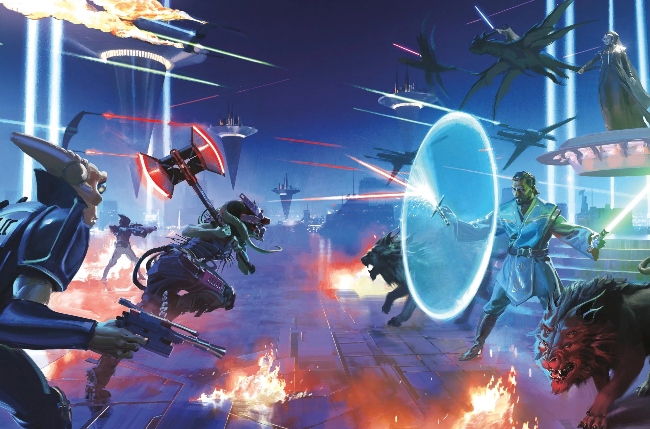
The Nihil are inextricably linked to the history of the Ro family. This is most immediately obvious in their symbology and lexicon. The three lightning bolts are an evolution of the three waves that members of the Path — among them Marda Ro, the founder of the Nihil — painted on their faces. Meanwhile, the insignia of the Eye of the Nihil — a swirling vortex — and the many invocations of meteorological phenomena — the call to “ride the storm,” the division of Nihil members into Storms, Clouds, Strikes, and Tempests, among others — hearken to the Ros’ history as refugees. The Evereni fled their homeworld after a Great Storm rendered the planet uninhabitable. They traveled the galaxy, often facing persecution because of their reputation for violence. The search for sanctuary brought Marda and her cousin Yana into the Path.
Marda became one of the Path’s most devoted followers, playing a critical role in the events that brought the Path into open conflict with the Jedi and precipitated its demise. True to the Path’s teachings, Marda hated the Jedi because she believed that they “abused” the Force. When the Jedi came to Dalna, Marda transformed the Path of the Open Hand into the Path of the Closed Fist, vowing to wage war on the Jedi. Following the Night of Sorrow and the revelation that Elecia Zeveron, the leader of the Path, was a Force user, Marda took the Gaze Electric and set out on her own.
Marda held on to the anti-Jedi sentiments that she’d learned from the Path, but they were now untethered from the cult’s ideology. “In A Closed Fist Has No Claws,” she says, “I never wear the waves of Force blue as I once did, nor often the gashes of lightning down my face.” Unlike the Path, the Nihil that she built were “[t]he opposite of community, of faith, of religion and family. The bond between me and the people following me is simply — nothing.”3

“A Closed Fist Has No Claws” is simultaneously a story about looking backward and looking forward. She recruited members of the Path into her new group by invoking history — or, rather, hagiography: “I told the Path missionaries a story about Dalna. It is a lie, a lie that put me at the center of their faith. The center of their desires.” She also pursued other Evereni, learning about the history and culture of her species from an Evereni who called himself Isren. Isren dubbed her Riferi, an Evereni word meaning “legacy,” “[t]he future cut of a knife we forge now.” Legacy looms over all that Marda does in her life after the Path. “This is for you,” she says to whichever future Ro is listening to her message.4
Marchion inherits Marda’s legacy. His relationship to his family’s history is, needless to say, complicated. As Eye, Marchion attempts to forge the Nihil into something new, but finds that — to borrow Marx’s parlance — the tradition of all dead generations weighs like a nightmare on his brain. Sometimes literally.
In The Rising Storm, Marchion journeys to the planet Rystan, where he frees the Great Leveler with the help of his cousin Kufa. Kufa is among a handful in the galaxy who still follow the Path of the Open Hand, and she interprets Marchion’s visit to Rystan accordingly. “You have come back to us,” she says to him in greeting. “You have returned to the Path.” Later she presses him about his reason for coming: “Do you bring us hope? Will you reopen the Hand? Will you deliver the message?” Marchion answers no: “It is not my place. I am no prophet.”5
Marchion’s conversation with Kufa is even more fascinating with the added context of Phase II. In suggesting that he might “reopen the Hand,” Kufa positions Marchion as a palingenetic figure, someone who might reverse the consequences brought about by the Path of the Closed Fist and restore the Path of the Open Hand as it once was. By reawakening the Leveler, Marchion is arguably continuing the Path’s war against the Jedi.
But he also, arguably, isn’t. True, Marchion hates the Jedi, just like the Path did. When Kufa sneers at “their golden robes and flashing blades,” she sounds not unlike Marchion. But Marchion doesn’t care about freeing the Force. He doesn’t care about balance. In Light of the Jedi, he describes the Republic as “[i]nvading, taking over, with all its rules and laws and particular brand of freedom that isn’t free at all,” with the “Jedi always just behind, absolutely convinced that every action you take is right and good.” Marchion hates the Jedi because they are an obstacle to his power and his freedom. He has no interest in carrying the Path’s torch. After freeing the Leveler, Marchion kills Kufa, symbolically severing his own cause from that of his ancestors.6
If only it were that easy to avoid family. In Path of Vengeance, we learn that Evereni have the ability to see the spirits of those who have died. Unlike Force ghosts, these apparitions are figments of imagination rather than literal manifestations of the dead. Marda sees Kevmo Zink, the Padawan who she led to death, while Yana sees her girlfriend Kor Plouth.
Marchion, meanwhile, is visited by family. In The Rising Storm, Asgar appears as a malevolent figure, belittling Marchion for his supposed weakness. Marchion dislikes these visits, especially from his great-grandmother. “He’d rather his father any day than this madwoman,” he thinks to himself when Marda manifests on the Gaze Electric in Temptation of the Force. Later, when she stands next to him on a barge, Marchion laments, “Too bad shoving her over wouldn’t hurt her.” He has little regard even for the chronicle that comprises “A Closed Fist Has No Claws”: “She had rambled about freedom and home, about her hunt for their people and her gradual descent into violence. Ro had found it useless as a child; it would be even more so now.”7
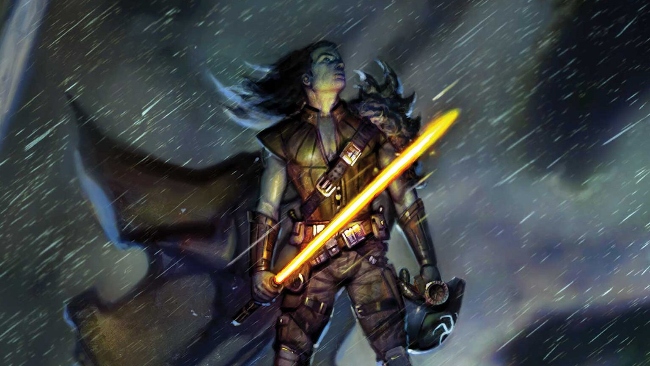
Yet for all the contempt he evinces toward Ros past, Marchion would be nothing without them. This is the central contradiction of Marchion Ro, and arguably the most fascinating thing about him: he both pushes away and pulls from his own history. He attempts to outrun history, only to run right back into it, like a Looney Tunes character.
Marchion Ro makes his own history. But he does not make it as he pleases.
Friedrich Nietzsche’s 1874 essay “On the Use and Abuse of History for Life” offers a useful heuristic through which we can understand Marchion’s relationship to his familial history. Nietzsche argued that while historical knowledge is important, we need to exercise caution, writing, “we need [history] for life and action, not for a comfortable turning away from life and action or merely for glossing over the egotistical life and the cowardly bad act.” “We wish to use history only insofar as it serves living,” he continued. “But there is a degree of doing history and a valuing of it through which life atrophies and degenerates.”
According to Nietzsche, we need to strike a balance between absorbing ourselves in history and ignoring it completely. Too much dwelling on history will leave a person stuck in the past: “The person who cannot set himself down on the crest of the moment, forgetting everything from the past, who is not capable of standing on a single point, like a goddess of victory, without dizziness or fear, will never know what happiness is.” Living in the here and now requires us to do some amount of forgetting. Otherwise we only ever repeat what came before us and never come up with anything new.
At the same time, we cannot untether ourselves from history completely. Nietzsche calls such individuals superhistorical and describes them thusly: “He forgets most things in order to do one thing; he is unjust towards what lies behind him and knows only one right, the right of what is to come into being now.” The superhistorical don’t dwell on the past at the expense of the present, but they are nonetheless dangerous: “a person who assumes such a stance could feel no more temptation to continue living and to participate in history.” Thus the superhistorical find themselves in the same morass as the history obsessives, unable to truly live.
One can make an argument that, in his selective regard and disregard for history, Marchion approaches the kind of balance to which Nietzsche aspired. By Marchion’s own admission, “my decision to delve into my family’s history…ended up giving me exactly what I’ve desired since I was a child.” At the same time, as we see in his attitude towards the Path, Marchion feels no obligation to fight the battles of the past or to champion lost causes.8
But alas, we find no real balance within Marchion. By Trials of the Jedi, Marchion has settled on his endgame: he intends to let the Blight spread across the galaxy, consuming all life. “Saving the galaxy was never the answer for me,” he tells Avar Kriss on Planet X, when he admits that his offer to help defeat the Blight was a lie. “If I did that, even if everyone knew I’d done it, even if I was even more of a hero than the Jedi…someday I would still die. I don’t want to be remembered. Eventually, everything that is remembered is forgotten. I want more.” By destroying all life, he would “make a choice for everyone in the galaxy that could not be reversed or contradicted,” thereby “proving the supremacy of my will.”9
In the last, Marchion becomes Nietzsche’s superhistorical man. Marchion seeks not just to end life, but also to end history. The contrast between him and Marda is apparent. Marda recorded her chronicle so that future generations of Ros could know where they came from. Everything she did was in service of forging a legacy, one that culminated in the rise of Marchion Ro, a man who wanted neither to be remembered nor to leave anything behind. He would be the last Ro, the last Evereni, and quite possibly the last living being in the galaxy. After learning from Isren that “Evereni” literally means “caretakers,” Marda implores her listener to “[t]ake care,” to safeguard what she built. Marchion, however, only wants to burn it all down.10
Marchion fails in his quest to eradicate life. At his trial, he is sentenced to live out the rest of his days on an asteroid prison. There, he’s cut off from outside communication, from companionship (save for his attendant droids), and, it turns out, from his past. Marchion expresses surprise “that he was not visited by his ancestors,” not even to kick him when he was down. As the closing words of Trials tell it, “no one came for Marchion Ro. Not even ghosts.”11
Marchion wanted to abandon history. In the end, history abandoned him.
- Edward Hallett Carr, What Is History? (New York: Alfred A. Knopf, 1962), 9, 35. ↩︎
- For those interested in the Star-Wars-as-history argument, I will selfishly direct you to two podcast episodes that I hosted, which can be listened to here and here. See also Chris Kempshall, The Rise and Fall of the Galactic Empire (New York: DK, 2024). ↩︎
- Tessa Gratton, “A Closed Fist Has No Claws,” in Tales of Light and Life (Lucasfilm Press, 2023), 42, 46. ↩︎
- Gratton, “A Closed Fist Has No Claws,” 48, 59-60. ↩︎
- Cavan Scott, The Rising Storm (New York: Del Rey, 2021), 28, 47. ↩︎
- Scott, The Rising Storm, 46; Charles Soule, Light of the Jedi (New York: Del Rey, 2021), 379. ↩︎
- Tessa Gratton, Temptation of the Force (New York: Del Rey, 2024), 69-70, 167. ↩︎
- Charles Soule, Trials of the Jedi (New York: Del Rey, 2025), 191. ↩︎
- Soule, Trials of the Jedi, 191-192. ↩︎
- Gratton, “A Closed Fist Has No Claws,” 60. ↩︎
- Soule, Trials of the Jedi, 375-376. ↩︎
 CLASHING SABERS