In the richly layered and impactful world of Andor, nothing is accidental, and everything has meaning. As season two has unfolded across its first six episodes, the show deepens its exploration of unity, rebellion, and the cost of war not only through plot and dialogue but also through visual motifs. Two recurring symbols emerge prominently in the first six episodes: circles and spiders. From the architecture on Chandrila to the ghorlectipods on Ghorman, circles and spiders pervade the visual language of the show and tell a story in and of themselves.
Across history, circles have been one of the most commonly used symbols of unity, wholeness, and continuity. Humans are drawn toward the shape because they convey a sense of safety and harmony. Evolutionary psychology suggests that this draw may be centered around the comfort and security of rounded shapes. In Andor, however, the circles are used for a different purpose. They dominate the landscape of the Mothma estate, from circular arches to circular doors and the rounded shapes of rooms, which are meant to draw the audience into a false sense of security. What appears to be safe is not. What appears to be comfortable is a lie. This aesthetic is a visual façade that conceals the truth of the political oppression, secrecy, and control that is really taking over.
Along with that, the circles on Chandrila, including the circles associated with the wedding traditions of their culture, imply a sense of closed systems of power. As the Sculdun and Mothma families—who are diametrically opposed in every way—are coming together to form an elite group that excludes the people Mon Mothma is fighting for, the noose tightens. In a manner of speaking, the circles are a trap that Mon Mothma is being encompassed by. Circles have no corners in which to hide, no breaks through which one can escape. There is nowhere Mon can go now that the connection between the two families has become one.
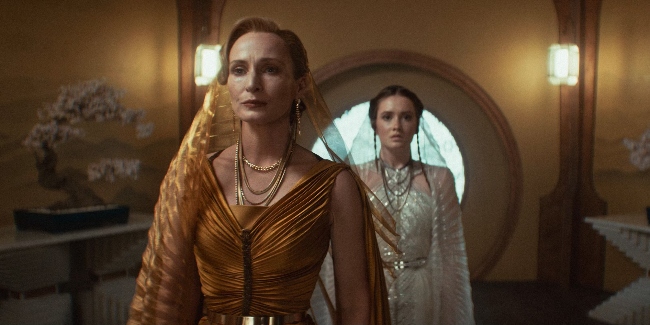
Such is why the dance scene at the end of the third episode has captivated audiences. In the scene, the entire wedding party is dancing in a circle as Mon and Luthen discuss the need to take care of the problem that Tay Kolma has become, right outside of the loop. Just as she has had to sacrifice her daughter to the traditions of her culture in order to cover up her role in the Rebellion, Mon is faced with the harsh reality of the cost of war in realizing that her childhood friend has now become a negative balance on the ledger of the Rebellion she is building. The cost of war is becoming very real and tangible to her.
After the discussion, she moves back into the circle to dance with everyone else. But the look on her face makes it very clear that she is not dancing for the reasons that everyone else is. She is not dancing because she feels free. She is dancing because she is trapped. The dance itself is a distraction as her mind processes who and what she is having to become for the greater good. There is no way out for her now that the cost is so high.

The symbolism of circles continues in the next three episodes of the show, which take audiences to the ill-fated planet of Ghorman. Again, the architecture is all circles and rounded arches. Even the town square is a circle, centered around the Monument of the Fallen. The Ghorman people are a culture of peace, unity, and wholeness, their world centered around the fabric that they make via the ghorlectipods.
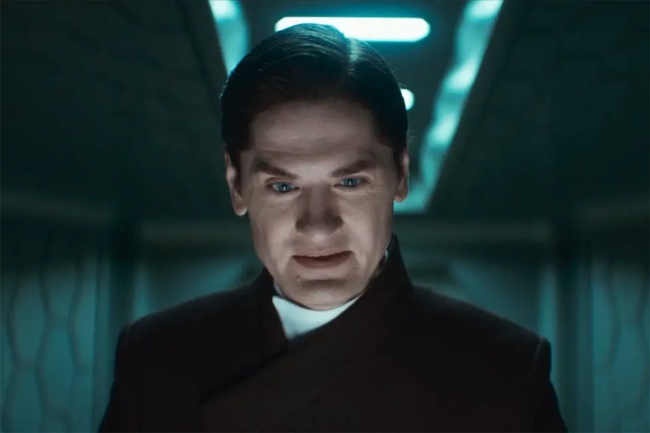
Yet again, though, the circles are a misnomer. Ghorman is beginning to fall apart. The Empire has decided to target the planet, and the shadow of that decision is beginning to loom (figuratively and literally, thanks to the armory the Empire is building). Syril Karn’s presence on the planet is a testament to this reality. He is like a virus, breaking into the inner circle of the Ghorman Front to try and break the circle from the inside.
It is intriguing, considering that perspective, that Cassian Andor himself would enter the Ghorman circle. More intriguing is the fact that while Cassian leaves Coruscant for Ghorman, Syril does the reverse. Nothing Tony Gilroy does is without purpose. This shows that both the Rebellion and the Empire carry some of the blame for the destruction of planets that is coming with the Galactic Civil War that looms.

That war, which is happening in the shadows, is not just breaking cultures apart. It is breaking people apart. There is a beautiful shot in the sixth episode of the season where Vel and Cinta reunite in a café. The shot of their reunion gazes through a window that is, unsurprisingly, a circle. What is compelling, however, is that that circle has a curved line running through it, with Vel on one side of the line and Cinta on the other. The two form a whole, but there is still a division between them that they have to work through.
Which leads to why spiders are so critical to the second arc of the season, and the importance that both circles and spiders exist in unison on Ghorman. Historically, spiders play many roles. On one side of the spectrum, they are weavers who bring together different ideas, cultures, and philosophies. Spider webs are circular, symbolizing unity and wholeness. On the other side of the spectrum, spiders are deceitful tricksters, weaving together lies that entrap their prey.
For a millennium, the people of Ghorman have lived in unity with the spiders that produce the silk they use for their well-known fabric. The spiders have sustained them, in a manner of speaking. That is changing now, and the people don’t even know how bad it truly is. What they believe is about a building is about so much more. The Empire is weaving a web of lies and propaganda in which they are getting trapped. Once more, the noose tightens.
Thanks to stories like Star Wars Rebels, audiences have an inkling of what is to come for the people of Ghorman: the Ghorman Massacre. This event will be the breaking point that leads Mon Mothma to formally announce the birth of the Rebellion. It will take scattered and disconnected sects, including the Maya Pei seen earlier in the season, and unite them. They will weave together, circle up, and become what audiences are familiar with.
Andor masterfully weaves its themes of entrapment, sacrifice, and unity through rich visual symbolism. The recurring motifs of circles and spiders are more than aesthetic choices—they are metaphors for the systems that bind, the lies that entangle, and the fragile alliances being spun. As season two draws to a close, it becomes clear that the series is not just building toward a rebellion but crafting a story of transformation, one that will resonate far beyond the galaxy it inhabits.

 CLASHING SABERS