Tales of the Empire, the new Star Wars series released on May 4th, is a beautiful exploration of how we react to injustice, who we become because of that reaction, and the paths we can end up following as a result.
The first three shorts, entitled The Path of Fear, The Path of Anger, and The Path of Hate, follow the story of Morgan Elsbeth, a Nightsister who watches her people, including her mother, get slaughtered by General Grievous and the Separatist army. This trauma sends her down a dark path where she chooses her anger time and again. Even when given the opportunity to do better, such as when the villagers of the planet she is Magistrate of beg her to do something that will support their efforts, she is so consumed by the hate she feels towards everything and everyone, all of it stemming from the genocide of her Nightsister clan, that she refuses.
What Elsbeth does not realize is that by serving the Empire, which she does by aligning herself with Admiral Thrawn in The Path of Anger, she is in fact serving the very force that brought an end to her people. While the Empire itself is technically a reorganization of the Republic rather than the Separatists, both were puppets in Palpatine’s play. Even if she had the information, though, it is uncertain whether or not it would change her path. Her anger has grown so strong that she will seemingly do anything to protect herself and herself alone.

All of this goes back to Yoda’s famous quote, “Fear leads to anger. Anger leads to hate. Hate leads to… suffering.” Elsbeth was raised to believe in her people and their abilities, which gave them strength through the Force and their dark magick. When that power is not enough, she is understandably afraid. It is not the fear itself that is wrong, but rather the choices she makes from it.
In The Path of Fear, the mother of the mountain clan that takes Elsbeth in after her clan’s demise, and gives her a choice when she says, “You must not assume just because someone does not want to fight, that they are not capable.” Essentially, she is conveying the same message as Yoda, telling Elsbeth that it is not about power. It is about how and when one wields that power. Thus, the mother is giving Elsbeth a choice to follow her fear, which has now resulted in the mountain clan being slaughtered too, or to choose a different path. A path of peace that lets go of the past rather than being consumed by it.
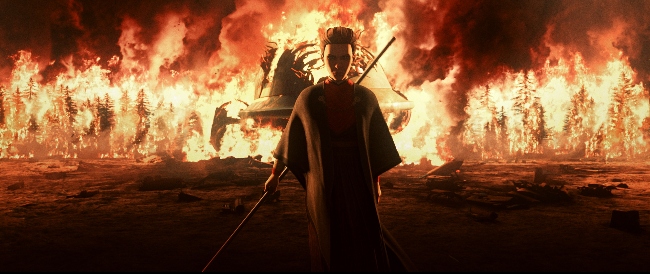
But at this point it is too late for Elsbeth. She has already chosen to let the fear consume her. The mother points to this by saying, “It appears your path is set, Morgan Elsbeth. I pity you, for I can see what is to come.” What comes is a life of anger and hate that will lead to her following Thrawn all the way to a distant galaxy where she will die a pawn in his grand scheme. She is, as the mother alluded to, pitiful.
Paralleling Elsbeth’s journey is one Barriss Offee, the former Jedi apprentice who bombed the Temple and framed Ahsoka Tano for it in season five of The Clone Wars. Her three episodes in the series, entitled Devoted, Realization, and The Way Out, pick up with her imprisoned during the events of Order 66. At this point, her fear about and anger towards what the Jedi have become as a result of the war has led her towards the path Elsbeth follows. A path of fear, a path of anger, a path of what will become, if the former are not properly dealt with, a path of all-consuming hate.
Like Elsbeth, Barriss’s people, the Jedi, have been more or less exterminated, which leads her to a choice that will determine her destiny. Enter Lyn, also known as The Fourth Sister, and the Grand Inquisitor, both former Jedi who have turned to the dark side and joined the newly formed Inquisitorius that will hunt down and kill the remaining Jedi. They offer Barriss the opportunity to join them, something she is willing to do because of the faith that she has lost in the way of the Jedi.
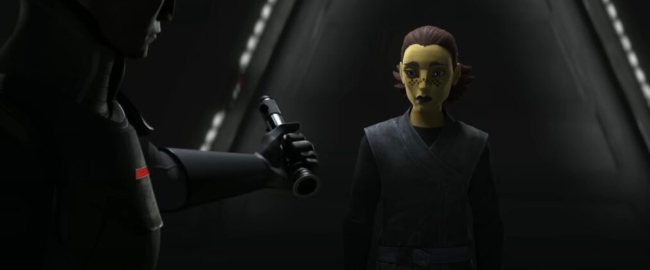
After facing the tests put in front of her, including killing another former Jedi to earn a spot in the Inquisitorial ranks, Barriss dons her new helmet, accepts her new identity, and kneels before her new master, Darth Vader. However, when she goes with Lyn on a mission to hunt a rogue Jedi, she begins to see the discord between what the Empire, and therefore the Inquisitorious, claims to be and the actions they choose to take.
For Barriss, the Empire is about bringing peace and order to the galaxy, something lost during The Clone War. Her actions, such as when she speaks peacefully to a child to learn the location of the rogue Jedi, reflect an intentionality in that direction. There is, as Barriss sees it, no reason to bring harm to a people who are clearly already suffering. Lyn does not see things the same way, though, and she murders all of the villagers save the child. Barriss begins to see that the peace and order that the Empire claims to be about are really control through fear and power.
When they eventually find the Jedi, a beautifully shot duel ensues. Clouded in fog, an allegory of the internal conflict arising within Barriss, Lyn and the Jedi clash sabers, one with the intention of murder, the other with the intention of survival. For Barriss, there is a third path, though. There is a path of laying down one’s weapons and choosing not to act out of anger and hate, as Lyn is, nor fear, as the Jedi is.
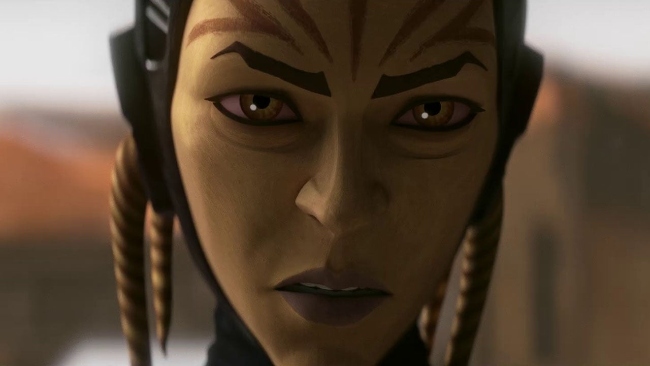
Eventually, The Jedi knocks Lyn down and goes in for the killing blow. Fear has begun to consume him. Barriss blocks the murderous strike and tells him, “You need to surrender.” She sees a path where they all walk away alive because she has not fully given in to her fear. As the two duel, Barriss intentionally stays defensive while the Jedi continues to attack her. When she realizes the futility of the fight, Barriss turns off her lightsaber and tells the Jedi, “I know what it’s like to be lied to, to be deceived.” She offers him a way out, one he seems to be ready to accept before he is killed from behind by The Fourth Sister.
This is the turning point for Barriss, the final straw that sends her false belief in the Empire crumbling down. Lyn’s actions, both in the village and with the Jedi, show Barriss the true colors of the Empire, much like what Elsbeth sees when the Empire refuses to work with her and the people of Corvus while blatantly telling her that they will gladly plunder her village and people for their resources, all with no thought to the consequences of their actions. In this moment, Barriss, like Elsbeth, is given a choice between following the Empire out of fear or having the courage and fortitude to risk her life so as not to become a cog in the Imperial machine. Barriss, unlike Elsbeth, chooses the path of courage. The path of the Jedi.
Barriss’s story picks up years later, on an icy desert plain reminiscent of Hoth, the wrinkles lining her face telling the story of one who has spent years trying to do better. Where Elsbeth had to dominate people in order to hold onto power, Barriss has spent years helping one individual at a time to keep the light alive in a generation of darkness. Where Elsbeth leaned into the fear of the weakness she felt watching her planet and people being massacred, Barriss works to absolve her wrongs by protecting a Force-sensitive child from the path of darkness she walked as an Inquisitor.

In the end, both Elsbeth and Barriss will die by the blade of a lightsaber. But how that death comes is more important than the death itself. By choosing the path of fear, anger, and hate, Elsbeth spends her life suffering her insecurities, only to die as a pawn in Thrawn’s game of power. Barriss, however, leaves a legacy of light and life because she chose to believe, even after everything she saw in The Clone Wars, that anyone, including The Fourth Sister, could make a choice to be better.
It is because of people like Barriss that empires fall. It is because of people like Barriss that hope stays alive. It is because of people like Barriss that we can see that no matter what choices we have made in the past, there is always the next right choice to make. The right choice to help the next generation while healing your own. The right choice to walk the path of light not because of what it can accomplish, but because of what it is. The right choice to be better than your worst day or worst decision. The right choice to be… more.

 CLASHING SABERS